The sari has entered its second century of global circulation, and the live argument is no longer whether the drape travels but who gets to say what it means. London's Design Museum answered with The Offbeat Sari, a major exhibition celebrating the contemporary sari, staged in 2023. Its curator, Priya Khanchandani, framed the garment as a metaphor for the layered definitions of India today. That framing has aged well.
The drape also travels alongside other traditions that crossed borders, and a natural companion read is this tour of festivals of light around the world. Both stories ask the same question of a custom: what survives the crossing?
More on cloth and culture sits in the culture hub. The record below stays with named institutions and named people: a museum exhibition, its curator, and the designers the museum chose to show. Sari fashion now runs from city commutes to red carpets, and every claim here traces to one of those sources.
What Exactly Is a Sari?
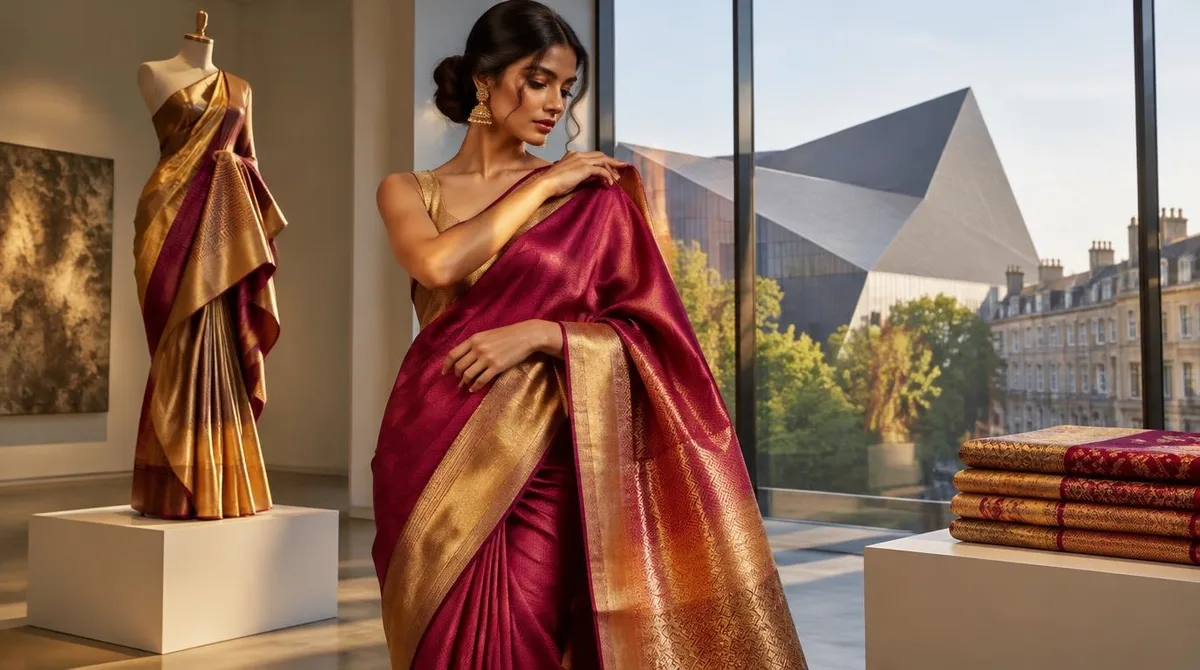
Per the reference record, a sari is a draped cloth and women's garment of the Indian subcontinent: an un-stitched stretch of woven fabric arranged over the body, one end attached at the waist, the other resting over one shoulder as a stole. It runs from 4.5 to 9 yards in length and 24 to 47 inches in breadth. The most common drape is the Nivi style, worn with a fitted bodice called a choli and a petticoat. The unstitched form is the design.
How Did a Museum Put the Sari at the Center?
The Design Museum ran The Offbeat Sari from 19 May to 17 September 2023, curated by its Head of Curatorial, Priya Khanchandani, and brought together dozens of saris from designers, wearers and craftspeople in India. The museum's own notes describe a garment in motion: designers experimenting with hybrid forms such as sari gowns and dresses, pre-draped saris and materials as unlikely as steel. Young commuters, the notes add, now wear saris with sneakers, while activists have embodied the drape as an object of protest.
That is museum presence with a thesis. The exhibition treated the sari not as a preserved relic but as a working site of design innovation, and the press agreed: the Evening Standard called it spectacular and gave it four stars.
Which Designers Sit in the Canon Now?
The exhibition's tour gave the canon a shape. It brought together 54 saris by India's leading designers, among them red-carpet work by Sabyasachi Mukherjee and Tarun Tahiliani, including versions worn by Lady Gaga and Deepika Padukone, per ABC News. Material experimenters held their own corner: the tour listed Raw Mango, Rimzim Dadu, NorBlack NorWhite and Akaaro by Gaurav Jai Gupta. Khanchandani's verdict on the group: many of these brands pioneered the sari for the modern, intellectual woman.
Where Does the Borrowing Debate Stand?
The debate the exhibition entered was about meaning, not length. Khanchandani has described growing up in a London family whose diaspora knew the sari mainly as something worn by somebody's grandma, and called its reinvention a powerful symbol of reclaimed heritage and social change. In that account, the wearers lead and the borrowers follow.
The museum's framing gives the hybrid forms their defense: the sari's unfixed form has always enabled it to morph and absorb changing cultural influences. A sari gown or a pre-draped version reads, in that light, as the next stop on a long route rather than a costume. The contested part is not the cloth. It is the credit, and the Design Museum's answer was to show the makers by name. This connects to our earlier piece, The Global Life of Indigo: One Dye's Route Through Fashion.
The recent record, in three lines: Readers following this should also see Why Fashion and Architecture Keep Borrowing Each Other's Lines.
- 2023: The Offbeat Sari runs at London's Design Museum, curated by Priya Khanchandani.
- 2023: the museum lists sari gowns, pre-draped saris and steel among its hybrid forms.
- 2026: the exhibition reaches Melbourne's Bunjil Place Gallery with 54 saris, per ABC News.
Conclusion: Six Yards, Still Unfixed
The sari's second century opened with an institution, a curator and a designer list, which is more structure than most garments get. The garment's own logic made it possible. An unstitched drape has no fixed pattern to defend, so every generation re-drapes it and argues about the result.
The verdict from the record is short. Global influence here is not diffusion. It is a continuous argument about who owns the drape, and the argument is now on the museum floor.